ds323x: Minimal driver for DS323x extremely accurate RTC #9838
Conversation


 jnohlgard
added
Type: new feature
jnohlgard
added
Type: new feature
 PeterKietzmann
left a comment
PeterKietzmann
left a comment
PeterKietzmann
left a comment
There was a problem hiding this comment.
@gebart code-wise I'm not convinced how/why the ds3233 and ds3234are separated like this. Is there reason why some files are common but the params files, headers and the test are not?
Besides that, the code looks good to me. I just ordered a device and can provide test after it arrived.
drivers/Makefile.dep
Outdated
|
|
||
| ifneq (,$(filter ds3234,$(USEMODULE))) | ||
| USEMODULE += ds323x | ||
| USEMODULE += ds323x_ds3234 |
There was a problem hiding this comment.
This name seems a bit weird to me. Is it even generated or used somewhere?
There was a problem hiding this comment.
It's just to get the right file compiled without special tricks to get it recognized as a file from the ds323x directory
| @@ -0,0 +1,4 @@ | |||
| # enable submodules | |||
| SUBMODULES := 1 | |||
There was a problem hiding this comment.
So far you just implemented ds3234.c. Do we actually need the SUBMODULES now?
There was a problem hiding this comment.
Implemented this way makes it easy to add a ds3231.c later on
| return -EIO; | ||
| } | ||
|
|
||
| if (ENABLE_DEBUG) { |
There was a problem hiding this comment.
To let the compiler syntax check the part even when enable debug is off
| } | ||
| uint8_t reg = 0; | ||
| ds3234_read_reg(dev, DS323X_REG_CONTROL, 1, ®); | ||
| reg &= ~(DS323X_REG_CONTROL_EOSC_MASK | DS323X_REG_CONTROL_INTCN_MASK | |
There was a problem hiding this comment.
Would you mind to spend a note which options you (un)set here? Is this a form of device reset?
There was a problem hiding this comment.
I'll add a comment. The bits rs1 rs2 select which frequency the sqw pin will output. The intcn bit selects whether the sqw pin is an interrupt output or a square wave signal output. The eosc bit enables the oscillator when it is cleared.

| @@ -0,0 +1,65 @@ | |||
| /* | |||
There was a problem hiding this comment.
Do you think it is necessary to have separate params files?
There was a problem hiding this comment.
Since ds3234 is spi connected and the others are i2c, I figured the configuration should be separate

|
Only the ds3234 is spi connected, the others are i2c (ds3231, ds3232). There is no ds3233 AFAIK. |

|
@gebart thanks for the immediate feedback. It wasn't clear to me that the other device is I2C based. Then I'm fine with the file-wise isolation. Let's wait until the device arrives. |
|
Sounds good 👍 |

|
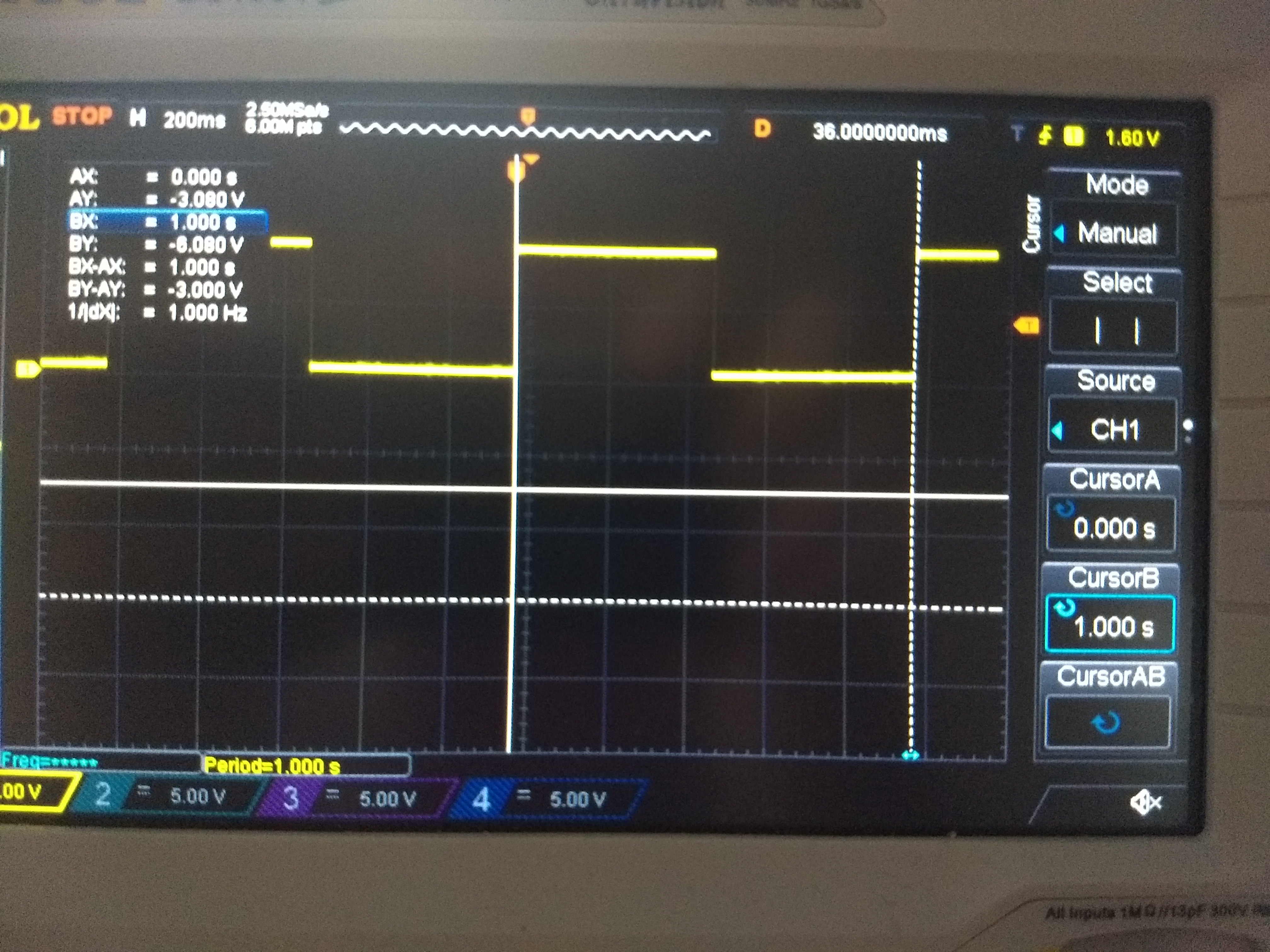
I just tested this on a Nucleo F030R8 and on a SAM R21 (after rebasing to apply #9885), and can confirm it works as intended. Here you can se the 1Hz square wave: Going through the device datasheet I saw there is no ID register or something like that to evaluate if device is actually present on the bus or not during initialization. Would it be worth it to add a function that writes and reads a byte from the SRAM present on the device? Maybe something like: bool ds3234_is_present(const ds3234_params_t *dev)
{
uint8_t value = 0x55, address = 0x0A, reg = 0;
ds3234_write_reg(dev, DS323X_REG_SRAM_ADDR, 1, &address);
ds3234_write_reg(dev, DS323X_REG_SRAM_DATA, 1, &value);
ds3234_write_reg(dev, DS323X_REG_SRAM_ADDR, 1, &address);
ds3234_read_reg(dev, DS323X_REG_SRAM_DATA, 1, ®);
if (ENABLE_DEBUG) {
print_str("Expected: 0x");
print_byte_hex(value);
print_str(" - Read: 0x");
print_byte_hex(reg);
print_str("\n");
}
return value == reg;
} |
|
@leandrolanzieri I would prefer to not touch the SRAM portion of the chip. What we could do instead is read back the written register and see that it matches what we expect, if you would like some more feedback to the application. |
|
@gebart yes, we could do that. The problem is that, with the current configuration, the control register is always 0. |
|
Maybe we could go without checking if the device is present for now? |
|
Can't you just write ones to RS1 and RS2 in the Control register, read it out, check, and reset again afterwards? We could leave this feature out, sure, but now that it's on the table I think it would be nice to implement it at once. |
Yes, I think this could be easily done, and having the feature would be nice. |


|
ping @gebart. |

|
@leandrolanzieri how about you take over this PR? You base your changes on @gebart's commit and I'll test/review then. @gebart do you agree? |
|
@PeterKietzmann sounds good! I will not be able to work any more on this PR |
 leandrolanzieri
force-pushed
the
pr/ds3234-pps
branch
from
leandrolanzieri
force-pushed
the
pr/ds3234-pps
branch
from
6c7f604 to
25ed4f4
Compare
|
@PeterKietzmann I rebased and applied the suggested changes. |
PeterKietzmann
left a comment
PeterKietzmann
left a comment
There was a problem hiding this comment.
@leandrolanzieri I left a few comments, please address them. Furthermore, what is your opinion about the pseudo-module preparation in this PR?
Other than that I ran the test on a nucleo-f103rb and got the expected 1Hz output
drivers/ds323x/ds3234.c
Outdated
| #include "ds323x_regs.h" | ||
| #include "fmt.h" | ||
|
|
||
| #define ENABLE_DEBUG (1) |
There was a problem hiding this comment.
Please disable by default
drivers/ds323x/ds3234.c
Outdated
| for (int k = 0; k <= 0x19; ++k) { | ||
| uint8_t dbg_reg = 0; | ||
| ds3234_read_reg(dev, k, 1, &dbg_reg); | ||
| print_byte_hex(k); |
There was a problem hiding this comment.
This has a dependency to the fmt module.
| #define DS3234_PARAM_SPI (SPI_DEV(0)) | ||
| #endif | ||
| #ifndef DS3234_PARAM_CS | ||
| #define DS3234_PARAM_CS (SPI_HWCS(0)) |
There was a problem hiding this comment.
I think GPIO_PIN(0, 0) would be the more common way here.
leandrolanzieri
removed
the
CI: ready for build
@PeterKietzmann I think it might be confusing to see that the DS323X family is there but actually only one device is supported. I believe for now we can skip that and just keep this minimal driver as DS3234 until an implementation of another device of the family is implemented. |

PeterKietzmann
left a comment
PeterKietzmann
left a comment
There was a problem hiding this comment.
@leandrolanzieri thanks for addressing. Code looks good and still works. Please squash all commits to a single one!

This driver currently only supports the SPI connected DS3234, and only
for initializing 1 Hz square wave output on the SQW pin, nothing else.
leandrolanzieri
force-pushed
the
pr/ds3234-pps
branch
from
860d924 to
a6f430b
Compare
leandrolanzieri
added
the
CI: ready for build

| */ | ||
|
|
||
| /** | ||
| * @defgroup drivers_ds3234 DS3234 Extremely Accurate SPI RTC |

There was a problem hiding this comment.
@gebart: I think the @ingroup is missing here. As a result the documentation is shown directly in modues in the doxygen doc. Care to make a follow up PR to address this?
6 participants


Contribution description
A simple device driver for enabling the square wave output on the DS3234 SPI RTC from Maxim.
This driver currently only supports the SPI connected DS3234, and only for initializing 1 Hz square wave output on the SQW pin, nothing else.
The intended use case is to use this for calibrating internal oscillators on different boards by connecting the square wave output to a GPIO interrupt pin, and through those measurements achieve better accuracy from cheaper timers.
The register map is the same for all DS323x, but only the DS3234 is implemented here.
Testing procedure
External hardware: https://www.sparkfun.com/products/10160
Required tools: Oscilloscope or logic analyzer
Configure the device parameters in ds3234_params.h, build and flash tests/driver_ds3234. Examine the SQW pin on the RTC using an oscilloscope or logic analyzer, see a 1 Hz square wave.
Issues/PRs references
nothing yet.