









✨ I write simple, stupid and hence, readable "okay" codes with less WTFs/min from code reviews - mostly in Flutter, Node.js.
✨ Industries: Offshore IT Industry, Digital Agency, Health, Education, Finance.
Things you should know -
- 🔭 Currently working on: Dart & Flutter
- 🌱 Getting better at: Flutter, Swift, Kotlin, Agile Software Development, Technical Product Management
- 📫 Reach me out: Shoot a mail at
⚡️ Languages






Level novice or no more worked


⚡️ IDE / Editor






⚡️ Data






⚡️ Frameworks / Platforms






⚡️ Tools










Worked (Alphabetical order)


⚡️ Github Status

📕 Latest Blog Posts
- Modernizing Monorepo Architectures: Principles & Trade-offs
- A Comprehensive Guide to Flutter Widget Previews (Beta)
- Silence Isn't a Barrier: My System for Redesigning Tech Leadership
- Missing Dart? When TypeScript Feels Like a Desert
- Ultimate Guide to Managing Multiple SSH Keys for Git and Server Access
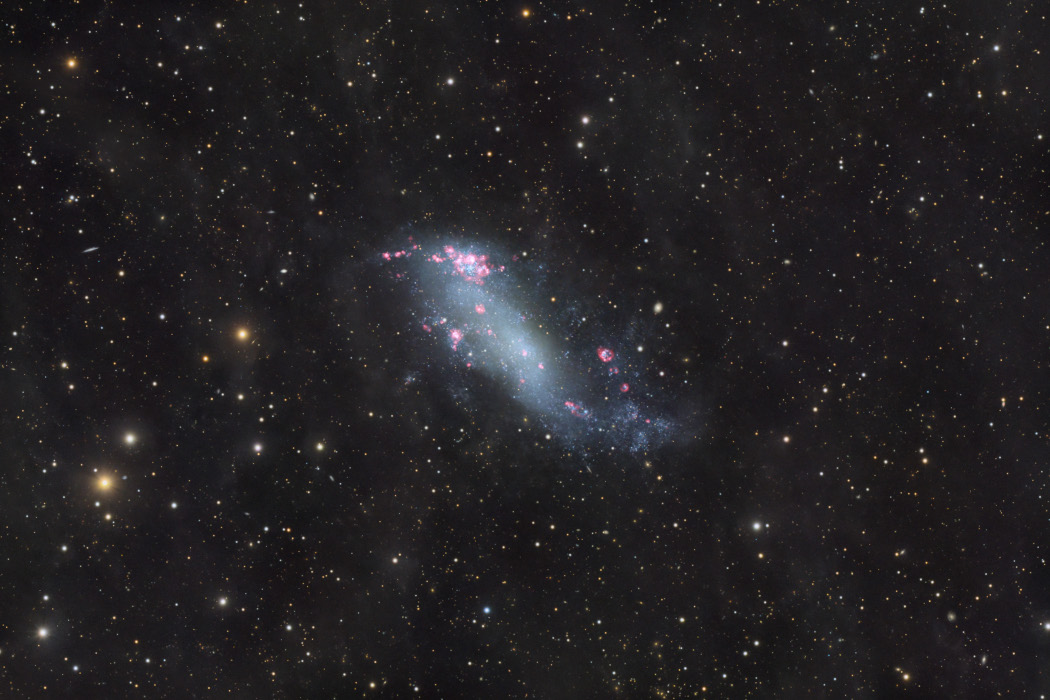
Grand spiral galaxies often seem to get all the glory, flaunting their young, bright, blue star clusters in beautiful, symmetric spiral arms. But small, irregular galaxies form stars too. In fact, dwarf galaxy IC 2574 shows clear evidence of intense star forming activity in its telltale reddish regions of glowing hydrogen gas. Just as in spiral galaxies, the turbulent star-forming regions in IC 2574 are churned by stellar winds and supernova explosions spewing material into the galaxy's interstellar medium and triggering further star formation. A mere 12 million light-years distant, IC 2574 is part of the M81 group of galaxies, seen toward the northern constellation Ursa Major. Also known as Coddington's Nebula, the faint but intriguing island universe is about 50,000 light-years across, discovered by American astronomer Edwin Coddington in 1898.
NASAI'm looking for sponsors to support my open source development, I appreciate your support! :)


