

Monitor and control your Docker containers through Home Assistant via MQTT.
This container publishes the status of your Docker containers to an MQTT broker and creates Home Assistant switch entities for each container. It allows you to:
- Monitor container states (running/stopped) in real-time via MQTT or Web Dashboard
- Track container resource metrics (CPU, memory, network, disk I/O)
- Control containers (start/stop) directly from Home Assistant
- Filter which containers to monitor using include/exclude lists
- Auto-exclude the monitoring container itself from the list
- Connect to local or remote Docker hosts via SSH
Originally created for Unraid servers but works with any Docker host.
A built-in Web UI is available on port 8080 to visualize the status of containers, MQTT connection, and perform basic actions.

This image supports multiple architectures:
- linux/amd64 (x86_64) - Intel/AMD processors
- linux/arm64 (aarch64) - ARM64 processors (Raspberry Pi 4, Apple Silicon, etc.)
Docker will automatically pull the correct image for your architecture.
docker run -d \
  --name docker-status-mqtt \
  -v /var/run/docker.sock:/var/run/docker.sock \
  -e MQTT_SERVER=YOUR_MQTT_IP \
  -e MQTT_USER=YOUR_MQTT_USER \
  -e MQTT_PASSWORD=YOUR_MQTT_PASSWORD \
pcarorevuelta/docker-status-mqtt-homeassistant| Variable | Description | Default | Required |
|---|---|---|---|
MQTT_SERVER |
MQTT broker IP/hostname | - | Yes |
MQTT_USER |
MQTT username | - | No |
MQTT_PASSWORD |
MQTT password | - | No |
MQTT_PORT |
MQTT broker port | 1883 | No |
PUBLISH_INTERVAL |
Status update interval (seconds) | 60 | No |
WEB_PORT |
Port for the Web UI | 8080 | No |
INCLUDE_ONLY |
Comma-separated container names to monitor | - | No |
EXCLUDE_ONLY |
Comma-separated container names to exclude | - | No |
ENABLE_METRICS |
Enable container metrics (CPU, memory, network, disk) | false | No |
Note: The monitoring container automatically excludes itself from the list to prevent self-monitoring.
| Variable | Description | Default | Required |
|---|---|---|---|
SSH_HOST |
Remote Docker host IP/hostname | - | No* |
SSH_PORT |
SSH port | 22 | No |
SSH_USER |
SSH username | - | No* |
SSH_PASSWORD |
SSH password | - | No* |
*Required only for SSH mode
docker run -d \
  --name docker-status-mqtt \
  -v /var/run/docker.sock:/var/run/docker.sock \
  -p 8080:8080 \
  -e MQTT_SERVER=192.168.1.100 \
  -e MQTT_USER=homeassistant \
  -e MQTT_PASSWORD=mypassword \
pcarorevuelta/docker-status-mqtt-homeassistantdocker run -d \
--name docker-status-mqtt \
-v /var/run/docker.sock:/var/run/docker.sock \
-p 8080:8080 \
-e MQTT_SERVER=192.168.1.100 \
-e ENABLE_METRICS=true \
pcarorevuelta/docker-status-mqtt-homeassistantdocker run -d \
--name docker-status-mqtt \
-p 8080:8080 \
-e SSH_HOST=192.168.1.50 \
-e SSH_USER=root \
-e SSH_PASSWORD=rootpassword \
-e MQTT_SERVER=192.168.1.100 \
-e MQTT_USER=homeassistant \
-e MQTT_PASSWORD=mypassword \
pcarorevuelta/docker-status-mqtt-homeassistant# Monitor only specific containers
docker run -d \
--name docker-status-mqtt \
-v /var/run/docker.sock:/var/run/docker.sock \
-p 8080:8080 \
-e MQTT_SERVER=192.168.1.100 \
-e INCLUDE_ONLY=plex,sonarr,radarr \
pcarorevuelta/docker-status-mqtt-homeassistant
# Exclude specific containers
docker run -d \
--name docker-status-mqtt \
-v /var/run/docker.sock:/var/run/docker.sock \
-p 8080:8080 \
-e MQTT_SERVER=192.168.1.100 \
-e EXCLUDE_ONLY=watchtower,portainer \
pcarorevuelta/docker-status-mqtt-homeassistantservices:
docker-status-mqtt-homeassistant:
image: pcarorevuelta/docker-status-mqtt-homeassistant
container_name: docker-status-mqtt
restart: unless-stopped
ports:
- "8080:8080"
volumes:
- /var/run/docker.sock:/var/run/docker.sock
environment:
- MQTT_SERVER=192.168.1.100
- MQTT_USER=homeassistant
- MQTT_PASSWORD=mypassword
- PUBLISH_INTERVAL=30
- ENABLE_METRICS=trueOnce running, the container will:
- Automatically create MQTT switch entities for each Docker container
- Publish container states to
homeassistant/switch/{container_name}/state - Listen for commands on
homeassistant/switch/{container_name}/set
The switches will appear in Home Assistant under MQTT integration with the ability to:
- View current container state (on = running, off = stopped)
- Start/stop containers by toggling the switch
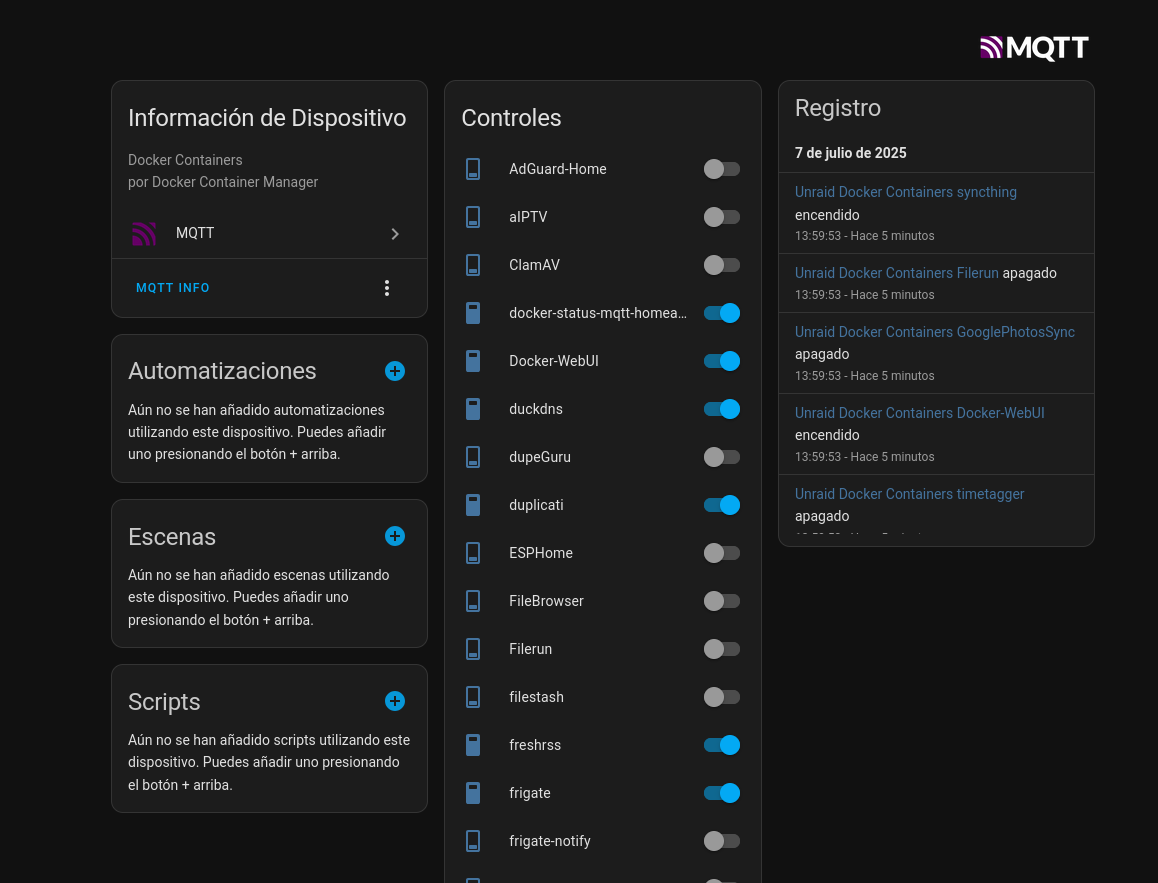
Example showing Docker containers as controllable switches in Home Assistant's MQTT integration
- State:
homeassistant/switch/{entity_prefix}{container}/state - Command:
homeassistant/switch/{entity_prefix}{container}/set - Config:
homeassistant/switch/{entity_prefix}{container}/config(auto-discovery)
When ENABLE_METRICS=true, additional sensor entities are created:
- CPU Usage:
homeassistant/sensor/{entity_prefix}{container}_cpu/state(%) - Memory Usage:
homeassistant/sensor/{entity_prefix}{container}_memory/state(%) - Memory Usage (MB):
homeassistant/sensor/{entity_prefix}{container}_memory_usage/state(MB) - Network RX:
homeassistant/sensor/{entity_prefix}{container}_network_rx/state(MB) - Network TX:
homeassistant/sensor/{entity_prefix}{container}_network_tx/state(MB) - Disk Read:
homeassistant/sensor/{entity_prefix}{container}_disk_read/state(MB) - Disk Write:
homeassistant/sensor/{entity_prefix}{container}_disk_write/state(MB)
The container includes comprehensive health checks that validate:
- MQTT Connectivity: Verifies connection to the MQTT broker
- Docker API Access: Tests the active connection method (socket/SSH/local commands)
- Process Health: Confirms the main service is running
- Service Activity: Checks for recent heartbeat updates
The health check automatically detects and validates only the active Docker connection mode.
Health checks run every 60 seconds with a 30-second timeout. The container is considered unhealthy after 3 consecutive failures.
You can manually run the health check:
docker exec container_name uv run healthcheck.pyOr check the container health status:
docker inspect --format='{{.State.Health.Status}}' container_nameIf you get a "Permission denied" error when accessing the Docker socket:
For Unraid users:
- Make sure you're running the container as root (default behavior)
- Verify the Docker socket path is correct:
/var/run/docker.sock:/var/run/docker.sock
For other systems:
# Option 1: Run with user matching docker group
docker run -d \
  --name docker-status-mqtt \
  --user $(id -u):$(getent group docker | cut -d: -f3) \
  -v /var/run/docker.sock:/var/run/docker.sock \
  -e MQTT_SERVER=YOUR_MQTT_IP \
  pcarorevuelta/docker-status-mqtt-homeassistant

# Option 2: Add your user to docker group
sudo usermod -aG docker $USER- Verify MQTT broker is accessible from the container
- Check MQTT credentials are correct
- Ensure MQTT_SERVER uses IP address or resolvable hostname
- GitHub: https://github.com/pcaro/docker-status-mqtt-homeassistant
- Issues: https://github.com/pcaro/docker-status-mqtt-homeassistant/issues
For development, you can use a .env file instead of environment variables:
- Copy
.env.exampleto.env - Fill in your configuration
- Run with:
docker run -d --name docker-status-mqtt --env-file .env pcarorevuelta/docker-status-mqtt-homeassistant
Pull requests are welcome. For major changes, please open an issue first to discuss what you would like to change.
MIT