Fix for date format mismatch #298
Conversation


Codecov Report
@@           Coverage Diff           @@
##             main     #298   +/-   ##
=======================================
  Coverage   95.89%   95.89%
=======================================
  Files          65       65
  Lines        2800     2804    +4
  Branches      418      420    +2
=======================================
+ Hits         2685     2689    +4
  Misses         73       73
  Partials       42       42
Continue to review full report at Codecov.
|


|
This looks like a reasonable solution. Any ideas why cuDF works while Pandas fails ? |

|
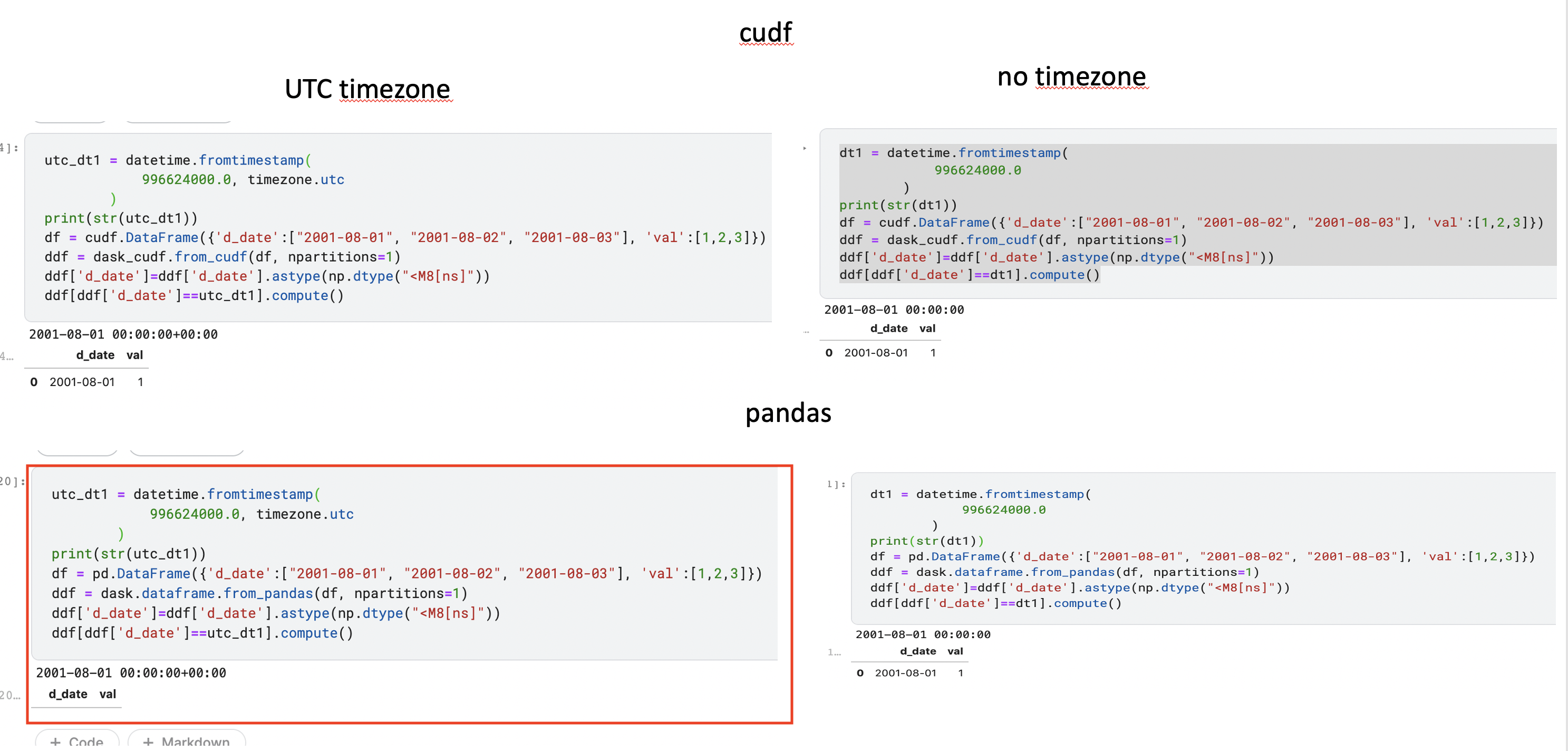
Hi @quasiben, Thanks for reviewing the PR and putting me in the right direction (I missed the part about why it works for CUDF) I tried digging deep into this and found the following, Both pandas and cudf seem to work for the local timezone. but pandas doesn't seem to work with UTC timezone. while executing the query, we are converting the literal timestamp value to the datetime value using the following function. Lines 160 to 165 in 61cbca9 example using the above function: Since we are only accepting UTC timezone currently, we may need to do the casting explicitly, what do you think? And One more point in the favour of handling date casting explicitly is the current version of code includes dask-sql/tests/integration/test_select.py Lines 120 to 127 in 61cbca9 Open for other ideas/Suggestions from everyone! |
|
Thank for digging into this @rajagurunath ! I didn't know dask-sql sets everything as UTC if TZ is not defined.
I suspect this is slower than what you have. |

 charlesbluca
left a comment
charlesbluca
left a comment
charlesbluca
left a comment
There was a problem hiding this comment.
Thanks for the work here @rajagurunath 😄 just a few comments:
| int(literal_value.getTimeInMillis()) / 1000, timezone.utc | ||
| ) | ||
|
|
||
| if sql_type == "DATE": |
There was a problem hiding this comment.
Would you mind adding a comment here linking to #296?
| if sql_type == "DATE": | |
| # address datetime format mismatch | |
| # https://github.com/dask-contrib/dask-sql/issues/296 | |
| if sql_type == "DATE": |
| if return_column is None: | ||
| return operand | ||
| else: | ||
| # handle datetime type specially |
There was a problem hiding this comment.
Same as above - just adding a link to #296
| # handle datetime type specially | |
| # address datetime format mismatch | |
| # https://github.com/dask-contrib/dask-sql/issues/296 |
| assert_frame_equal(result_df, datetime_table) | ||
|
|
||
|
|
||
| def test_date_casting(c, datetime_table): |
There was a problem hiding this comment.
Thinks we don't actually need datetime_table here? Since we only use the context here
| def test_date_casting(c, datetime_table): | |
| def test_date_casting(c): |

|
@rajagurunath Thanks for working on this! One thing I noticed was that when I perform a date comparison with this PR: import dask.dataframe as dd
import pandas as pd
from dask_sql import Context
df = pd.DataFrame({'d_date':["2001-08-01", "2001-08-02", "2001-08-03"], 'val':[1,2,3]})
ddf = dd.from_pandas(df, npartitions=1)
c = Context()
c.create_table("df", ddf)
query = "SELECT val, d_date FROM df WHERE CAST(d_date as date) >= DATE '2001-08-02'"
c.sql(query).compute()I get: When I run the same code without this PR I get: Do you know what might be happening here? |

|
Working on a PR to supersede this one in #343 |

5 participants


Initial attempt to solve: #296
Explicitly handled the type conversion for the
datecolumn and a literal value. And wondering if there is any better way to handle this datetime casting. Happy to know everyone's thoughts on this!