Enhance gc to support deleting tensor buffer in advance#16409
Enhance gc to support deleting tensor buffer in advance#16409sneaxiy merged 7 commits intoPaddlePaddle:developfrom
Conversation


 sneaxiy
force-pushed
the
feature/advance_gc
branch
5 times, most recently
from
sneaxiy
force-pushed
the
feature/advance_gc
branch
5 times, most recently
from
dbb80d6 to
134e9a3
Compare

refine gc code
test=develop
sneaxiy
force-pushed
the
feature/advance_gc
branch
from
134e9a3 to
a93a9ee
Compare
test=develop
sneaxiy
force-pushed
the
feature/advance_gc
branch
4 times, most recently
from
7b675aa to
493cd06
Compare
test=develop
sneaxiy
force-pushed
the
feature/advance_gc
branch
4 times, most recently
from
06b1fd6 to
adf5e09
Compare
fix ctest eager deletion disable bug
test=develop
sneaxiy
force-pushed
the
feature/advance_gc
branch
from
adf5e09 to
7b72c11
Compare
sneaxiy
force-pushed
the
feature/advance_gc
branch
from
7b72c11 to
796cc2c
Compare
test=develop
sneaxiy
force-pushed
the
feature/advance_gc
branch
from
796cc2c to
78fb3a6
Compare

| template <typename T> | ||
| struct OpInfoFiller<T, kNoNeedBufferVarsInference> { | ||
| void operator()(const char* op_type, OpInfo* info) const { | ||
| info->infer_no_need_buffer_vars_ = [](const VariableNameMap& inputs, |

There was a problem hiding this comment.
curious about when will these three parameters be used to get the NoNeedBufferVars, seems now we just return the parameters specified in the macro as an unordered_set?
There was a problem hiding this comment.
I reserve these parameters for future use. Some ops may not need some forward inputs or outputs when some attribute is true/false. For example, batch_norm_grad_op does not need Bias when use_mkldnn is false.

| static constexpr OpInfoFillType kFillType = kType; | ||
| }; | ||
|
|
||
| using OpRegistryClasses = std::tuple< // NOLINT |
There was a problem hiding this comment.
Ugly but scalable codes here. I rewrite OpInfoFillTypeID::ID() method because the character number limit is set to be 80 in a line.

| if (ctx->HasOutput(framework::GradVarName("X"))) { | ||
| auto out_dims = ctx->GetInputDim(framework::GradVarName("Out")); | ||
| ctx->SetOutputDim(framework::GradVarName("X"), out_dims); | ||
| } |

There was a problem hiding this comment.
Maybe the above code is confusing, if the ctx->HasOutput(framework::GradVarName("X") is False, there not need call AddPositionEncodingOpGrad .
There was a problem hiding this comment.
I am confused with these codes too. I just follow the original logic.
| ++iter) { | ||
| bool ok; | ||
| auto result = | ||
| ExtractComputationOpFromLastLivedVar(*iter, i, shrink_func, &ok); |
There was a problem hiding this comment.
actually I am a little bit confused about ExtractComputationOpFromLastLivedVar function. I know it want to get the last op which will use this variable, but in reference count part, do we need to care about which op generate this variable? What's the impact if we only care about the ops use this variable (the variable is used in the input part)
There was a problem hiding this comment.
ExtractComputationOpFromLastLivedVar returns (1) the last ops which read this variable if read ops exist, or (2) the last one op which writes this variables if read op does not exist. See HERE in details.
| continue; | ||
| } | ||
|
|
||
| for (auto &out_pair : op_base->Outputs()) { |
There was a problem hiding this comment.
Do we need to care about outputs here?
There was a problem hiding this comment.
Yes, we should care about outputs for in-place operation.
3 participants


For example, gc can collect data buffer of input
Yinelementwise_add_gradop before this op runs. In the meanwhile, shape and lod ofYcan be kept whenelementwise_add_gradop runs.Op developers can use
DECLARE_NO_NEED_BUFFER_VARS_INFERENCEto declare a class that indicates the unused-buffer tensors.For example, inputs of concat op
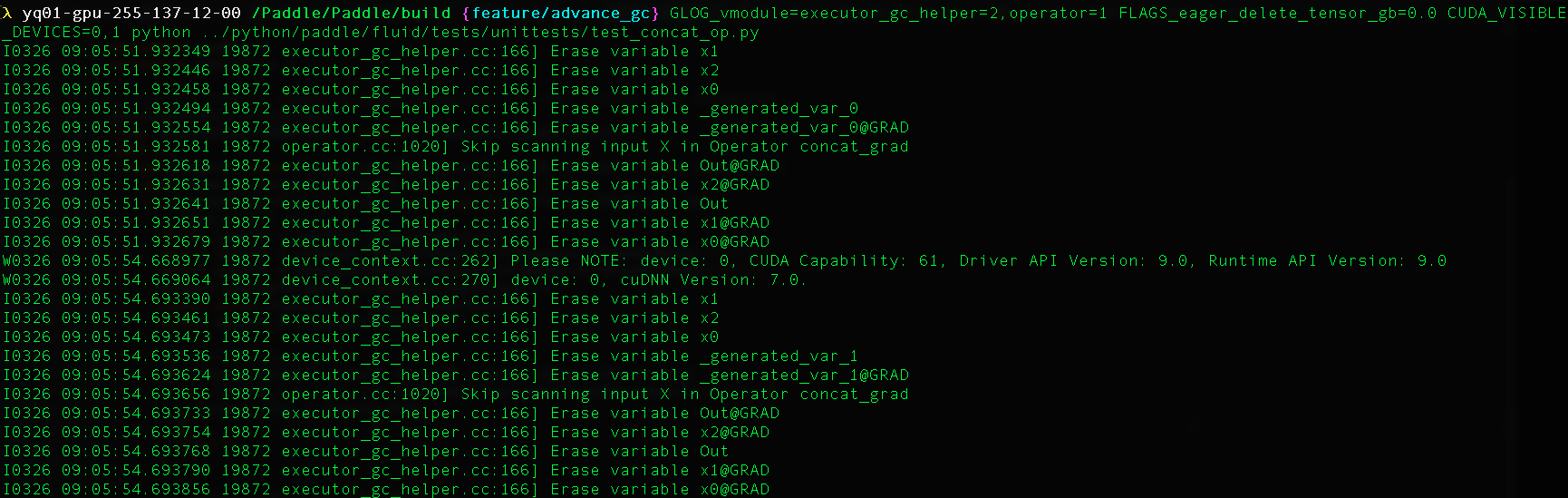
x0,x1,x2can be deleted before concat_grad op runs: