




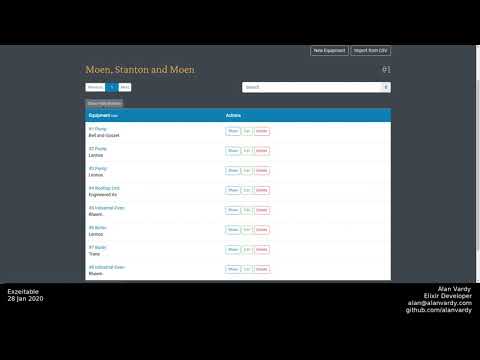
Dynamic, live updating datatables that takes a database query and a module, and make the magic happen. Ideal for quickly adding CRUD interfaces on an admin backend.
Features:
- Full text search
- Sorting
- Periodic refresh
- Bootstrap friendly and easily configured for other CSS frameworks.
- Customizable everything (and if something isn't, open an issue!)
- Powered by Phoenix LiveView and Postgres.
Documentation can be found at https://hexdocs.pm/exzeitable.

This package requires a Postgres database, Phoenix, and Phoenix LiveView.
The package can be installed by adding exzeitable and Phoenix Live View to your list of dependencies in mix.exs:
def deps do
  [
    {:exzeitable, "~> 0.5"},
  ]
endSearch requires the pg_trgm extension for Postgres.
Create a new migration
mix ecto.gen.migration add_pg_trgmAnd add the following code to your migration file
  def up do
    execute("CREATE EXTENSION pg_trgm")
  end

  def down do
    execute("DROP EXTENSION pg_trgm")
  end
Then migrate
mix ecto.migrateAdd the boilerplate to a new module.
defmodule YourAppWeb.Live.File do
  @moduledoc "User's File table"
  alias YourAppWeb.Router.Helpers, as: Routes
  import Ecto.Query

  use Exzeitable,
    # Required
    repo: YourApp.Repo,
    routes: Routes,
    path: :file_path,
    action_buttons: [:show, :edit, :custom_button],
    query: from(f in File),
    fields: [
      image: [virtual: true],
      title: [hidden: true],
      description: [hidden: true],
    ],

    # Optional
    debounce: 300

  # The callback that renders your table
  def render(assigns), do: ~H"<%= build_table(assigns) %>"

  # Field functions, called when virtual: true or function: true
  def image(socket, file) do
    img_tag(file.url, class: "w-100")
    |> link(to: Routes.file_path(socket, :show, file))
  end
end
Options can be added to either your module (as seen above), or in the template (As seen below) or both.
If an option is defined in both the template option will replace the module option. The only exception is :fields which must be specified in the module.
This is where you can specify the query that forms the default data of the table. Everything the table does is with a subset of this data.
query = from(f in Files)
render(conn, "index.html", query: query)Call the table from your template
<h1> My Awesome Files </h1>
<%= YourAppWeb.Live.File.live_table(@conn, query: @query, action_buttons: [:show, :edit], assigns: %{user_id: @current_user.id}) %>:repoThe module for your repository. Example:YourApp.Repo:routesYour route module. Example:YourAppWeb.Router.Helpers:pathThe base path for your resource. Example::site_path:fieldsA keyword list where the atom is the ecto field and the value is a keyword list of options. Example:metadata: [label: "Additional Information"]:queryA Ecto.Query struct, the part before you give it to the Repo. Example:from(s in Site, preload: [:users])
action_buttons: [:new, :edit, :show, :delete]A list of atoms representing action buttons avaliable for the user to use. This does not do authorization, the routes will still be available.per_page: 20Integer representing number of entries per page.debounce: 300Sets how many miliseconds between responding to user input on the search field.refresh: falseRequeries the database every x milliseconds, defaults to false (disabled).disable_hide: falseDisable hide and show functionality for columns, including not showing the buttons.pagination: [:top, :bottom]Whether to show the pagination above and belowtext: Exzeitable.Text.DefaultThe text that appears on the table, you can replace this with your own custom module.assigns: %{}Passes additional assigns to socket.assigns. Keep your payload small!
Under the fields key, you can define a keyword list of atoms with keyword values. The map holds the options for that field. All of these options are optional.
fields: [
          name: [function: true],
          age: [order: false],
          metadata: [label: "Additional Information", virtual: true, hidden: true],
        ]
The following field options are available (with their defaults):
label: nilSet a custom string value for the column headingfunction: falsePass (socket, entry) to a function with the same name as the fieldhidden: falseHide the column by default (user can click show button to reveal)search: trueWhether to include the column in search results. See the important note below.order: trueDo not allow the column to be sorted (hide the sort button)virtual: falseThis is shorthand for [function: true, search: false, order: false] and will override those settings. Intended for creating fields that are not database backed.
IMPORTANT NOTE: Search uses ts_vector, which is performed by Postgres inside the database on string fields. This means that you cannot search fields that are not string type (i.e. integer, datetime, associations, virtual fields). Make sure to set search: false or virtual: true on such fields.
Needed to build links where more than one struct is needed, i.e. link("Show Post", to: Routes.user_post_path(@conn, :show, @user, @post))
The official docs if you would like to learn more.
If you define one of the below options you then need to define the other.
Continuing the example of users and posts:
resources "/users", UserController do
  resources "/posts", PostController
end
The users Exzeitable does not need the 2 options below, but the posts Exzeitable does. Because all of its routes are different. The following will be needed to make the posts Exzeitable work:
belongs_to: :userparent: @user
Make sure that you include the :user_id in your query.
You will need to pass the parent option in from the template.
Almost no CSS styling is included out of the box. I have added generic classes elements in the table in the hopes of making the table as CSS framwork agnostic as possible.
I have included a Bootstrap SASS example in the CSS Module
Suggestions, bug reports and contributions are very welcome! Please open an issue before starting on a pull request however as I would hate to have any of your efforts be in vain.
This project uses the asdf version manager and docker-compose
# Clone the project from GitHub
git clone [email protected]:alanvardy/exzeitable.git
cd exzeitable

# Start postgres
docker-compose up -d

# Install dependencies
asdf install
mix deps.get

# Build assets, and run the test suite
mix check