from typing import Any, List
import torch
from pytorch_lightning import LightningModule
from torchmetrics import MaxMetric
from torchmetrics.classification import Accuracy
from torchmetrics.regression import MeanSquaredError

from src.models.components.simple_dense_net import SimpleDenseNet


class MNISTLitModule(LightningModule):
    """Example of LightningModule for MNIST classification.

    A LightningModule organizes your PyTorch code into 5 sections:
        - Computations (init).
        - Train loop (training_step)
        - Validation loop (validation_step)
        - Test loop (test_step)
        - Optimizers (configure_optimizers)

    Read the docs:
        https://pytorch-lightning.readthedocs.io/en/latest/common/lightning_module.html
    """

    def __init__(
            self,
            net: torch.nn.Module,
            lr: float = 0.001,
            weight_decay: float = 0.0005,
    ):
        super().__init__()

        # this line allows to access init params with 'self.hparams' attribute
        # it also ensures init params will be stored in ckpt
        self.save_hyperparameters(logger=False)

        self.net = net

        # loss function
        self.criterion = torch.nn.CrossEntropyLoss()

        # use separate metric instance for train, val and test step
        # to ensure a proper reduction over the epoch
        self.train_acc = Accuracy()
        self.val_acc = Accuracy()
        self.test_acc = Accuracy()
        self.one_mse = MeanSquaredError()

        # for logging best so far validation accuracy
        self.val_acc_best = MaxMetric()

    def forward(self, x: torch.Tensor):
        return self.net(x)

    def on_train_start(self):
        # by default lightning executes validation step sanity checks before training starts,
        # so we need to make sure val_acc_best doesn't store accuracy from these checks
        self.val_acc_best.reset()

    def step(self, batch: Any):
        x, y = batch
        logits = self.forward(x)
        loss = self.criterion(logits, y)
        preds = torch.argmax(logits, dim=1)
        return loss, preds, y

    def training_step(self, batch: Any, batch_idx: int):
        loss, preds, targets = self.step(batch)

        # log train metrics

        # acc = self.train_acc(preds, targets)
        acc = (preds == targets).sum() / len(preds)
        self.log("train/loss", loss, on_step=False, on_epoch=True, prog_bar=False)
        self.log("train/acc", acc, on_step=True, on_epoch=True, prog_bar=True)

        # we can return here dict with any tensors
        # and then read it in some callback or in `training_epoch_end()` below
        result_dict = {"loss": loss, "preds": preds, "targets": targets}
        if self.global_rank == 0 and self.global_step == 100:
            print(f"\n!training_STEP rank-0 {len(result_dict)}  {result_dict}")
        # remember to always return loss from `training_step()` or else backpropagation will fail!
        return result_dict

    def training_step_end(self, outputs):
        if self.global_step == 100:
            print(f"\n!training_STEP_end rank-{self.global_rank} {len(outputs)} {outputs}")

    def training_epoch_end(self, outputs: List[Any]):
        # `outputs` is a list of dicts returned from `training_step()`
        print(f"!\ntraining_EPOCH{self.current_epoch}_end rank-{self.global_rank}  {len(outputs)}")

    def validation_step(self, batch: Any, batch_idx: int):
        loss, preds, targets = self.step(batch)

        # log val metrics
        acc = self.val_acc(preds, targets)
        self.log("val/loss", loss, on_step=False, on_epoch=True, prog_bar=False)
        self.log("val/acc", acc, on_step=False, on_epoch=True, prog_bar=True)

        return {"loss": loss, "preds": preds, "targets": targets}

    def validation_epoch_end(self, outputs: List[Any]):
        acc = self.val_acc.compute()  # get val accuracy from current epoch
        self.val_acc_best.update(acc)
        self.log("val/acc_best", self.val_acc_best.compute(), on_epoch=True, prog_bar=True)

    def test_step(self, batch: Any, batch_idx: int):
        loss, preds, targets = self.step(batch)

        # log test metrics
        acc = self.test_acc(preds, targets)
        self.log("test/loss", loss, on_step=False, on_epoch=True)
        self.log("test/acc", acc, on_step=False, on_epoch=True)

        self.log("test/loss-ddp", loss, on_step=False, on_epoch=True, sync_dist=True)
        self.log("test/acc-ddp", acc, on_step=False, on_epoch=True, sync_dist=True)

        return {"loss": loss, "preds": preds, "targets": targets}

    def test_epoch_end(self, outputs: List[Any]):
        pass

    def on_epoch_end(self):
        # reset metrics at the end of every epoch
        self.train_acc.reset()
        self.test_acc.reset()
        self.val_acc.reset()

    def configure_optimizers(self):
        """Choose what optimizers and learning-rate schedulers to use in your optimization.
        Normally you'd need one. But in the case of GANs or similar you might have multiple.

        See examples here:
            https://pytorch-lightning.readthedocs.io/en/latest/common/lightning_module.html#configure-optimizers
        """
        return torch.optim.Adam(
            params=self.parameters(), lr=self.hparams.lr, weight_decay=self.hparams.weight_decay
        )
Brief
When using 4 GPUs with DDP strategy with
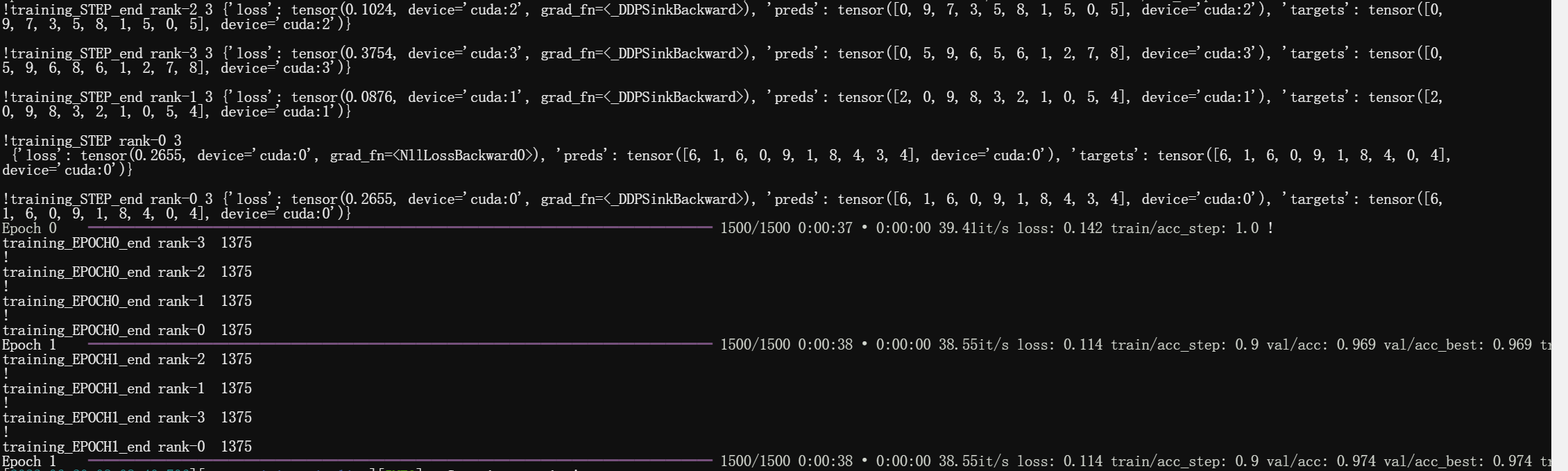
batch_size=10in themnist_datamodule, the batch number shown behind the progress bar is1500, which doesn't coincide with either the55000 (all datapoints)/ 4 (world_size) / 10 (batch_size)=1375or55000 (all datapoints) / 10 (batch_size)=5500.Env: 4 GPUs on 1 Node
pytorch-lightning 1.6.4
torch 1.10.0
torchelastic 0.2.0
torchmetrics 0.9.1
torchtext 0.11.0
torchvision 0.11.0
To reproduce
And add some print statements in
mnist_module(The full modified version is below) and trypython train.py trainer=ddp datamodule.batch_size=10 trainer.max_epochs=2